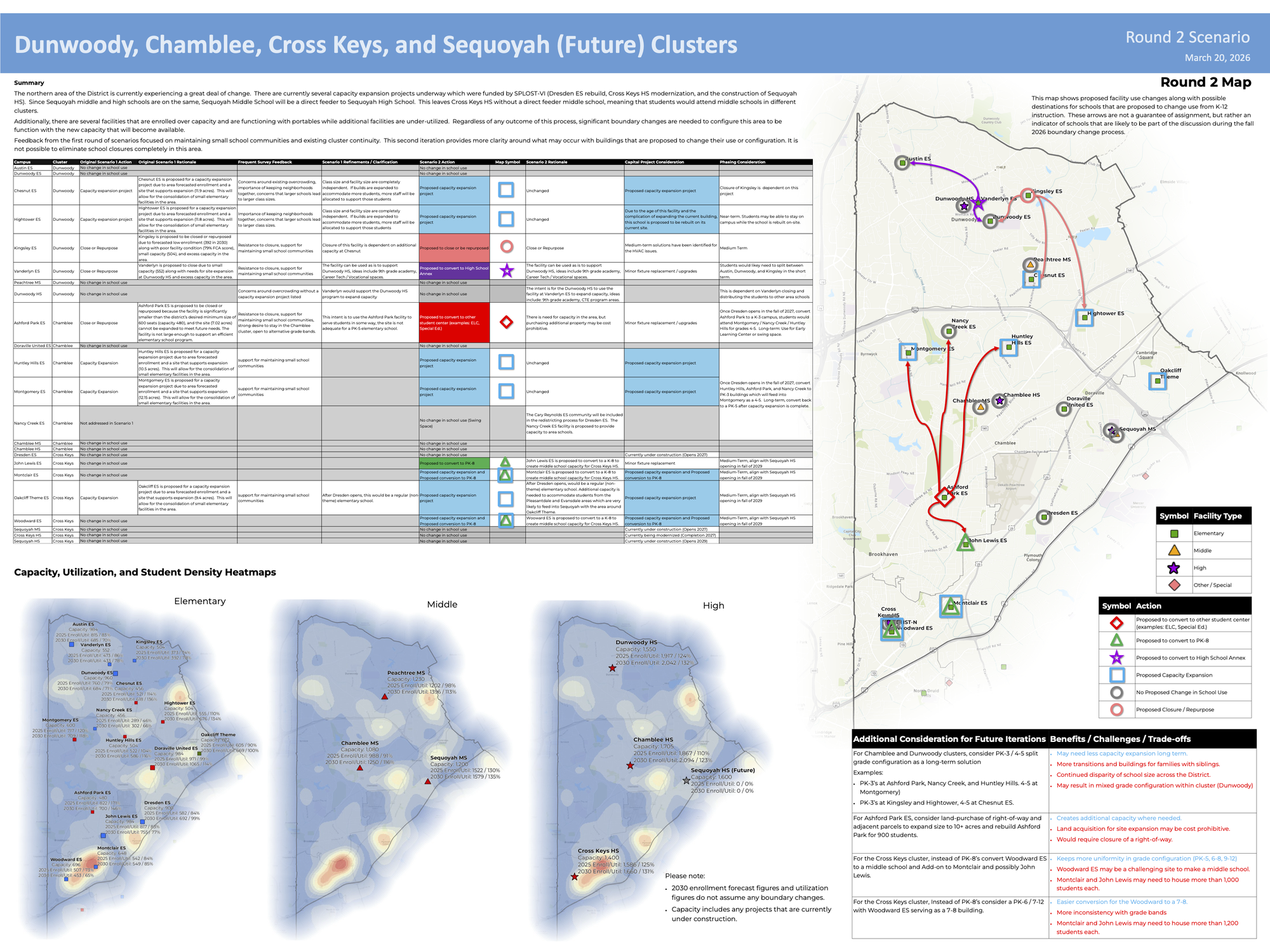
Families at Vanderlyn Elementary could face multiple school reassignments under DeKalb County School District's Round 2 Student Assignment Project scenarios, and the school's parent-teacher organization says the district's own numbers prove the plan won't work.
The Vanderlyn Elementary PTO published a detailed public statement on Tuesday, July 21, challenging the district's proposal to close the school and convert it into a high school annex to relieve overcrowding at Dunwoody High School. The PTO argues there are not enough seats in the Dunwoody cluster to absorb displaced students, a situation it calls a "waterfall cascade" that would force children out of their current schools to make room for others. The PTO did not cite specific cluster-level seat counts in its statement, framing the claim as based on the district's own data.
The pushback arrives amid institutional uncertainty about the SAP's future. At the Monday, July 13 DeKalb County School Board meeting, the board pulled an $850,000 contract with OGR Public Health Group LLC, a community planning firm that would have continued the SAP initiative. Sarita Smith, who headed the SAP process for the district, resigned in May and had not been replaced as of that meeting. District 2 Board Member Whitney McGinniss raised concerns that the process seemed too rushed.
When the district announced Round 2 scenarios at a Friday, March 20 news conference, Interim Superintendent Norman C. Sauce III said the district had roughly 90,000 students spread across capacity for 110,000 seats. "Doing nothing is no longer an option," Sauce said at the time.
Five objections
The PTO statement lays out five specific concerns:
- The seat-count math does not work based on district data.
- The plan introduces temporary placements followed by additional reassignments, requiring students to move more than once.
- The proposal affects middle and high school pathways, but no clear high school plan has been provided.
- The timeline is too aggressive.
- Capital improvements must be completed or fully guaranteed before any closures occur.
The PTO also questions the district's reliance on COVID-era enrollment data, arguing that many families temporarily left public schools during that period, skewing long-term projections.
Expansion, not closure
Rather than shuttering Vanderlyn, the PTO proposes the district evaluate it as a candidate for expansion toward a 600-student efficiency benchmark, noting the school shares a campus with Dunwoody High School. The PTO also points to the planned opening of Sequoyah Middle and High School as a factor that could ease overcrowding pressure at Dunwoody High without closing an elementary school.
The PTO says discussions indicate Vanderlyn students would likely be split between neighboring schools if the building closes, contradicting public messaging about whole-school transitions. That scenario, the PTO argues, is fundamentally different from combining two half-capacity buildings and would create significant feeder disruption.
Process stalled
Dr. Triscella Weaver, the district's chief of access and opportunity, presented a revised SAP approach at the July 13 board meeting: community action teams of 50 to 75 people would guide Phase 1, starting with clusters most affected by current construction projects. Weaver's proposed timeline calls for planning through August, community engagement through October, and a presentation to the school board in December.
The district has not publicly responded to the Vanderlyn PTO's specific objections as of Thursday, July 23.
How to respond
The district's community feedback page remains active at dekalbschoolsga.org/divisions/access-and-opportunity/sap. The PTO is encouraging families to submit comments that are calm, solution-oriented, and focused on facility planning and cluster-level impacts.