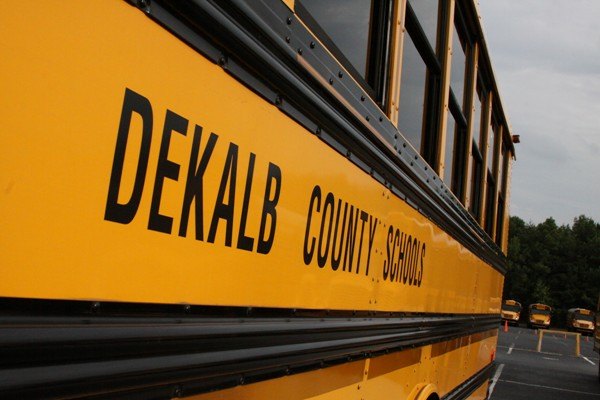
The roughly 50,000 DeKalb County students who ride a school bus each day are boarding an increasingly propane-powered fleet. With diesel prices surging and the district facing a separate $12 million budget hole, the cheaper fuel is providing measurable relief.
Bernardo Brown, DCSD's transportation director, said the district has been gradually replacing diesel buses in its 1,100-plus fleet with propane models. "Propane has proven to be an incredibly cost effective and reliable fuel," Brown said in a report published Friday, July 24, by The Champion Newspaper.
The price gap is wide. ROUSH CleanTech, the propane-technology manufacturer that compiled the data, reported diesel prices in Georgia reaching $5.50 per gallon in 2026 amid global supply disruptions. The company said propane held steady around $1.40 per gallon. Those figures could not be independently verified, and ROUSH CleanTech has a commercial interest in propane adoption.
The gap grew after Gov. Brian Kemp's state fuel tax exemption expired at midnight on June 2, adding what ROUSH CleanTech said was 37 cents per gallon to diesel costs.
The diesel crunch extends well beyond Georgia. A May 2026 survey by the National Association for Pupil Transportation found that 14 percent of districts reported fuel costs more than 20 percent above their 2025-26 budgets, with another 42 percent reporting overages of 6 to 20 percent, according to Education Week. The vast majority of the nation's 500,000 school buses still run on diesel.
Georgia's propane push
DeKalb is one of 34 Georgia school districts running propane buses, part of a statewide fleet of more than 2,000 propane-powered buses that transported up to 160,000 students daily during the 2025-26 school year, according to ROUSH CleanTech. Four of the state's largest districts use the fuel: DeKalb, Atlanta Public Schools, Fulton County Schools, and Henry County Schools.
ROUSH CleanTech said propane buses run 90 percent cleaner than the EPA's most stringent heavy-duty engine standard, emitting fewer greenhouse gases, nitrogen oxides, and particulate matter than diesel.
Why it matters now
The fuel savings land as DCSD navigates a $12 million ESPLOST VI overpayment it must return to City Schools of Decatur ($9.1 million) and Atlanta Public Schools ($2.1 million), according to the district's official statement. The error, caused by a missing certificate of distribution in 2022, has already forced the board to pause more than $119 million in capital projects. Those pauses include new bus purchases, fire alarm upgrades, and construction at Kittredge and Allgood elementary schools, according to a July 15 report by Rough Draft Atlanta on the July 13 board meeting.
The exact number of DCSD's buses already running on propane has not been publicly disclosed. The district's website says it is "replacing aging diesel-powered buses over time with low-emission or alternative fuel vehicles, including some that are fueled by propane."
The school board was expected to finalize decisions on the capital project pauses by the end of July, according to WSB-TV's July 12 report. Whether the propane transition continues at its current pace depends in part on that vote.