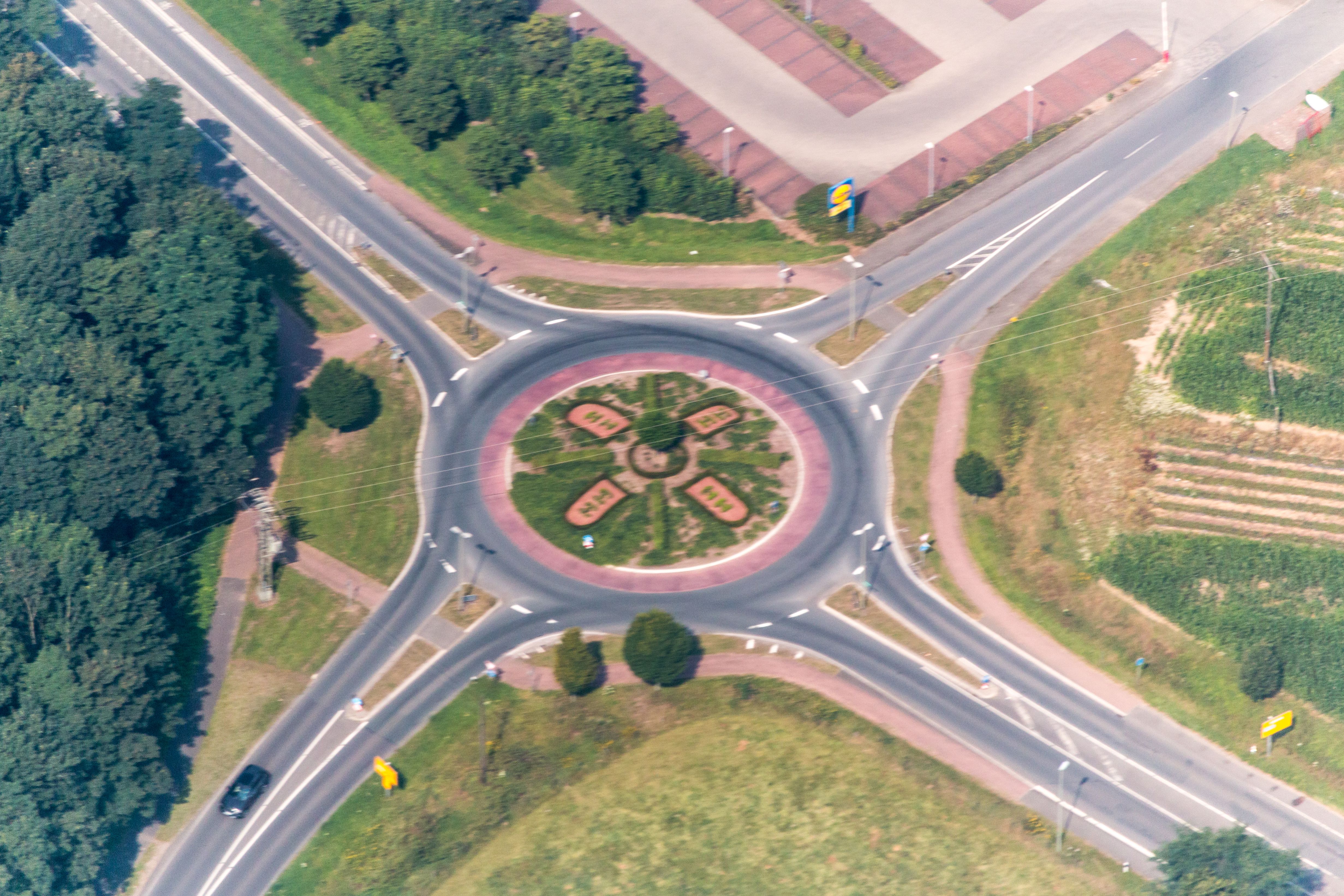
Crash rates at Brookhaven's Ashford Dunwoody Road and Windsor Parkway intersection have climbed 163% from their pandemic-era low, according to an independent analysis that now questions whether the city should proceed with a $7.24 million roundabout.
David Felfoldi, who publishes the Brookhaven Brief newsletter, reported Thursday, Sept. 10, that the exposure-adjusted crash rate at the intersection reached about 1.42 crashes per million vehicle passages in both 2024 and 2025. That is up from roughly 0.54 in 2021.
The rise matters because the roundabout was selected largely on safety grounds. A 2022 evaluation by the Georgia Department of Transportation (GDOT), called an Intersection Control Evaluation (ICE), scored the roundabout 6.7 and a traffic-signal alternative 6.2. The ICE weighed safety, traffic operations, cost, environmental impacts and stakeholder input.
Felfoldi's analysis argues that while the roundabout came out ahead in that comparison, the margin was not a wide one, and that several inputs the city relied on in October 2022 look different today.
Several conditions have changed since that evaluation. School speed cameras have been installed, and Ashford Dunwoody Road's speed limit dropped from 40 mph back to 35 mph in June 2025 — reversing a 2016 increase that had been made to keep the road compliant with state speed-detection permitting rules. The project budget has grown roughly 70%, from an original estimate of about $4.27 million to $7.24 million. The project is funded with about $5.80 million in federal money and $1.45 million in local dollars.
Felfoldi's analysis also noted that the signal alternative was not a simple traffic light. It required a northbound left-turn lane on Ashford Dunwoody, an eastbound right-turn lane on Windsor Parkway and a southbound right-turn lane on Ashford Dunwoody. Both options called for meaningful roadway reconstruction.
The original concept report projected the roundabout would cut fatal and injury crashes by about 78% and property-damage-only crashes by 39%. The signal was projected to provide roughly the same reduction in property-damage crashes but about half the roundabout's reduction in fatal and injury crashes.
Still, Felfoldi noted that the injury-crash rate has stayed within a relatively consistent historical range over most of the past decade. The 2025 rate sits near the lower end of that range, though the data do not yet show a sustained downward trend.
Project scope narrowed but tree concerns persist
The Brookhaven City Council voted unanimously Aug. 25 to remove the planned 750-foot multi-use path along Windsor Parkway from the project, Rough Draft Atlanta reported. The roundabout, about 1,000 feet of shared-use path along Ashford Dunwoody Road and pedestrian improvements remain in the construction scope.
The path removal may not spare many trees. At an Aug. 18 public meeting, Councilmember Madeleine Simmons asked Public Works Director Jeffery Littlefield whether roughly 95% of tree impacts would still occur without the path. Littlefield confirmed they would, explaining that the roundabout's design requires Windsor Parkway to shift north regardless of whether a path runs alongside it, as the Brookhaven Brief reported.
A city tree survey presented at the same meeting identified 206 trees impacted out of 306 surveyed. About 63% of affected trees are 14 inches or less in diameter, and roughly 66% sit within existing public right-of-way.
What comes next remains unclear
Brookhaven Public Works said after the Aug. 25 vote that no revised plans or alternative concepts had been developed. Updated tree, property and cost impacts cannot be estimated until that design work is finished.
Approximately $744,600 has already been spent on preliminary engineering, split 80/20 between federal and local funds. Right-of-way acquisition is complete at an estimated cost of about $3 million. Construction had been anticipated for 2027.
No Brookhaven city official has publicly responded to Felfoldi's call for an updated ICE study using current traffic volumes, crash data through 2025, the new 35 mph speed limit and revised costs. The fate of the roughly $5.80 million federal share if the city switched from a roundabout to a signal also remains unanswered.